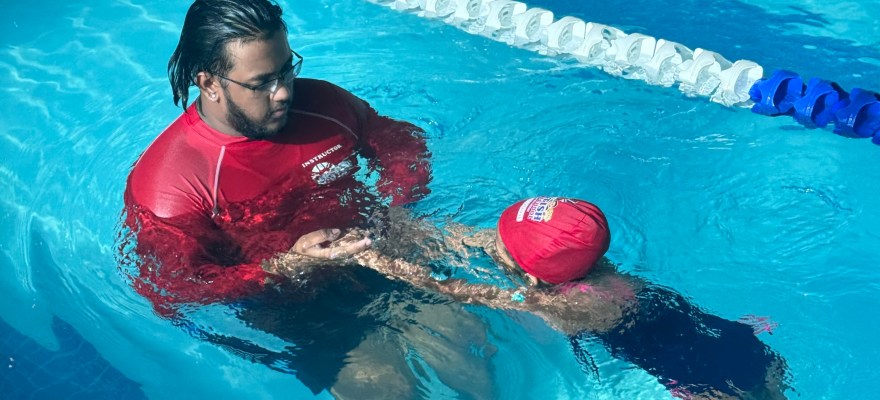
British Swim School is reshaping what it means to feel safe and confident in the water
By Soe Kebbabe
For many New York families, swimming lessons sit comfortably on the childhood activity roster. For swimming, at its core, is a life-saving skill. And according to Phil Turner, owner and operator of British Swim School in Brooklyn, Queens, and Staten Island, it is also one of the most emotionally transformative skills a person can learn.
“Swimming is one of the few activities where confidence, independence, safety, and physical ability all intersect at once,” Turner says. “When someone learns to trust themselves in the water, especially after fear or hesitation, it changes the way they see themselves.”
That philosophy now anchors the organization’s refreshed brand position, “Every Age. Every Stage.” More than a tagline, it reflects an intentional shift to broaden who swim education is for.
Traditionally centered on young children, swim instruction is often overlooked as a lifelong skill. British Swim School is working to change that by expanding access for infants, teens, adults, and individuals with special abilities.
“At any point in life, people can convince themselves they can’t learn,” Turner says. “Maybe it’s an adult who feels embarrassed that they never learned. Maybe it’s a parent worried their child will struggle. Or someone who had a bad experience years ago. We want families to understand there is no deadline for learning. Water safety belongs to everyone.”
In New York City, surrounded by rivers, beaches, pools, and year-round travel, Turner believes that message is especially urgent.
“People associate drowning prevention with summer,” he says. “But water exposure happens constantly. Hot tubs in winter, travel, backyard pools. Risk doesn’t follow a season.”
For British Swim School, the goal is not simply teaching strokes. It is building a long-term relationship with water grounded in confidence, awareness, and safety.
More Than a Lesson: Building Confidence Early
That process begins far earlier than many parents expect. British Swim School offers classes starting as young as three months old, introducing infants and toddlers to water in a calm, developmentally appropriate environment.
As children grow, instruction evolves from basic water acclimation to survival skills, stroke development, and endurance. The pacing is individualized, allowing instructors to meet each student’s emotional readiness as much as their physical ability.
“There’s no benefit in rushing,” Turner says. “We want progress to feel empowering, not stressful.”
A Lifelong Relationship with Water
Turner’s own connection to swimming began in the suburbs of San Francisco, where he swam competitively through high school and began coaching at 16. In 2018, he returned to the industry as owner and operator of British Swim School.
When it comes to learning to swim, some arrive fearless, others arrive, afraid to put their face underwater.
“People bring a lot into the pool with them,” Turner says. “Our job is to meet them where they are.”
That includes older learners, a group Turner says is often overlooked.
“Many adults simply never had the opportunity,” he explains. “Or fear got in the way. That doesn’t mean it’s too late.”
Relearning What’s Possible at Any Age
Research suggests that a significant portion of adults lack strong swimming skills, an issue particularly relevant in a city so closely tied to water. For many, the barrier is not physical ability, but emotional resistance.
“There’s often shame attached,” Turner says. “People assume they should have learned as a child.”
British Swim School’s approach is intentionally gradual, beginning with water comfort and basic safety before advancing to stroke development or fitness swimming.
“Fear doesn’t disappear through pressure,” Turner says. “People learn best when they feel safe.”
For many families, the impact extends beyond the pool. Children often become more confident in other areas of life, more willing to try new activities, and more comfortable with independence.
“You can actually see the shift happen,” Turner says. “A child realizes they can do something they once thought they couldn’t.”
Water Safety as Everyday Responsibility
As summer approaches, Turner hopes families think beyond seasonal lessons and view swimming as essential life preparation.
“The best time to learn water safety is before you need it,” he says.
He compares it to teaching children to use seat belts or to practice street safety.
“We see water safety as a social responsibility,” Turner says. “Not just a service.”
Whether it is a toddler splashing for the first time, a nervous teenager rebuilding confidence, or an adult finally deciding to learn, the mission remains the same.
“We are fun, we are gentle, and we are safe.”
In a city defined by water, that mission has never felt more essential. Visit British Swim School in Staten Island for more information.
SPONSORED CONTENT