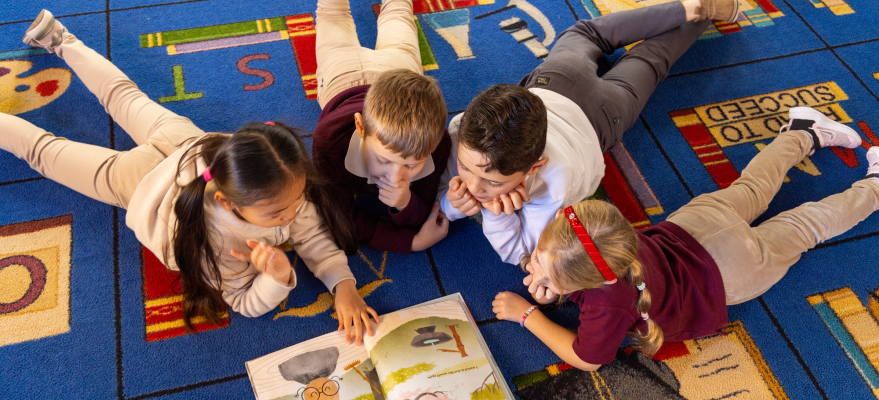
In a world of instant information, streaming content, and immersive video games, it’s not surprising people ask whether school libraries still matter. While libraries may not compete with technology, there is no doubt that they remain active playgrounds of discovery—spaces in which students cultivate skills that are increasingly difficult to develop elsewhere.
Libraries invite children into stories that help them understand both themselves and others. A young child listening to a picture book learns to recognize emotions, anticipate reactions, and appreciate different perspectives. They encounter characters facing challenges, making difficult decisions, navigating relationships that they themselves may be navigating, and overcoming adversity in many forms.
These experiences strengthen empathy—the ability to understand and share the feelings of another person. In an age when so much communication happens through screens, books still offer a uniquely human approach to step into someone else’s world. Through reading, students practice emotional intelligence, learn to recognize complex emotions, appreciate different viewpoints, and engage more thoughtfully with the people around them.
Reading also develops something increasingly rare: the ability to focus. Unlike many digital experiences that reward rapid responses and stimulation to reach the next level, books require students to slow down, pay attention, and remain engaged over time. Following a plot, understanding a character’s motivations, or wrestling with a challenging idea requires patience. These habits help students become stronger learners, better problem-solvers, and more resourceful thinkers.
As the American Association of School Librarians notes, “The school library is a unique and essential part of a learning community.” Recognizing this, some schools, like Staten Island Academy, have chosen to expand their libraries to include small reading nooks, breakout spaces with white boards to encourage group projects and author visits to ignite their curiosity through personal connection.
Don’t misunderstand, digital tools and games can also encourage creativity, collaboration, and innovation. But independent reading, the joy of picking out picture books to take home, the thrill of signing the back of a first library card and the wonder of scanning shelves imagining the next read, exercises a different set of intellectual and emotional muscles. Libraries ask students to imagine rather than simply observe, to reflect rather than react, and to think deeply rather than just log on. In an increasingly distracted world, libraries continue to offer something invaluable: the space and opportunity to become both thoughtful readers and thoughtful human beings.
Sponsored Content